

Antimicrobial peptides in oral medicine: From mechanisms to clinical translation
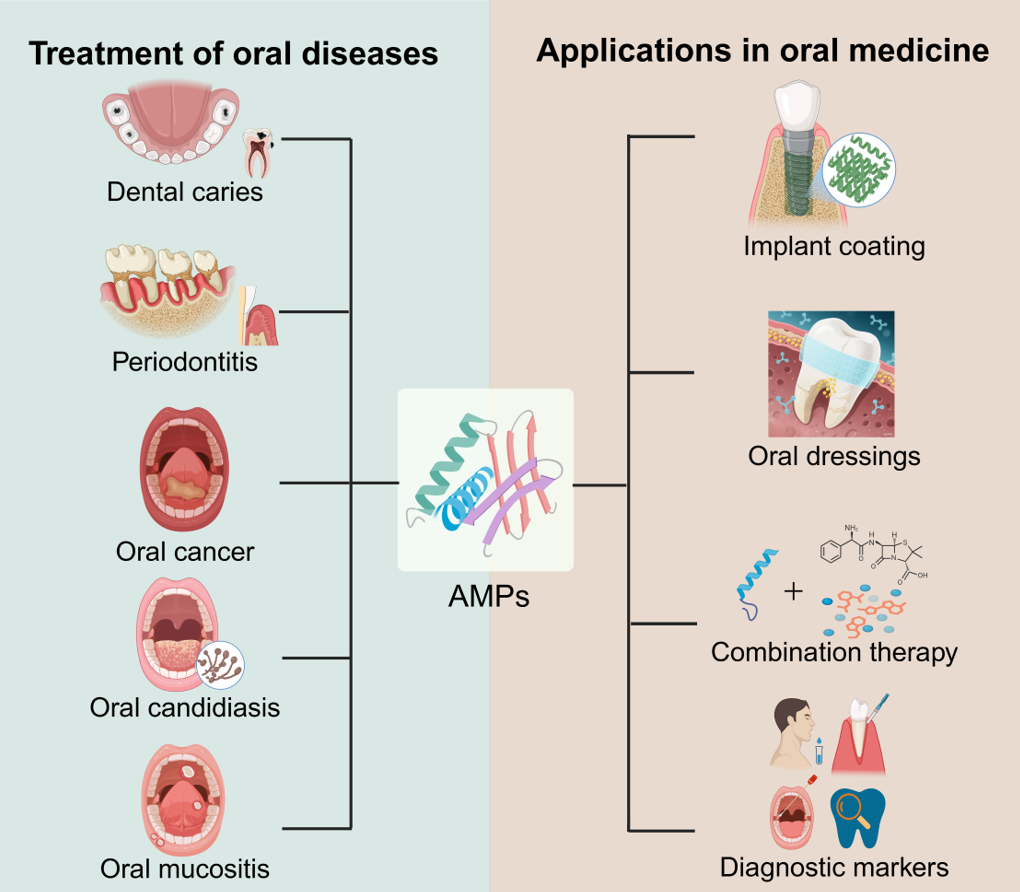
Roles in oral disease treatment and applications in oral medicine of AMPs.
GA, UNITED STATES, December 9, 2025 /EINPresswire.com/ -- Antimicrobial peptides (AMPs) exhibit broad-spectrum antimicrobial activity, low propensity to induce bacterial resistance, and multifunctional properties including immunomodulation and tissue regeneration promotion.This study comprehensively reviews the classification, antimicrobial mechanisms, and therapeutic applications of AMPs in major oral diseases such as dental caries, periodontitis, oral cancer, oral candidiasis, and oral mucositis. The research also analyzes key challenges in clinical translation (stability, cytotoxicity, immunogenicity, production costs) and corresponding solutions, while exploring their applications in implant coatings, oral dressings, combination therapy, and diagnostic markers, providing a robust theoretical basis for advancing oral disease treatment.
Oral diseases, including dental caries, periodontitis, and oral cancer, affect approximately 3.5 billion people worldwide. Traditional treatments mainly rely on antibiotics, but the widespread emergence of bacterial resistance has significantly reduced their efficacy. Hence, the need for safe and effective alternative therapies remains.
Antimicrobial peptides (AMPs), key components of the innate immune system, are small-molecule polypeptides widely existing in nature. Unlike traditional antibiotics that target specific metabolic pathways, AMPs primarily act by physically destroying microbial cell membranes—a unique mechanism that minimizes the risk of inducing resistance. Additionally, AMPs possess multiple biological functions such as regulating immune responses, reducing inflammation, and promoting tissue repair, with high biocompatibility to human cells.
In a new study(doi: https://doi.org/10.1016/j.tdr.2025.100046) published in Translational Dental Research, a team of researchers from China reviewed AMP classification, antimicrobial mechanisms, and roles in treating oral diseases.
“In the treatment of dental caries, AMPs like Temporin-GHa derivatives, ZXR-2, and GH12 can inhibit the growth of cariogenic bacteria such as Streptococcus mutans, interfere with biofilm formation, and even promote tooth remineralization,” shares senior and co-corresponding author Qiang Feng. “For periodontitis, human-derived AMPs (e.g., α-defensins, β-defensins) and synthetic peptides (e.g., Nal-P-113) effectively kill periodontal pathogens, regulate inflammatory responses by inhibiting pro-inflammatory cytokine secretion, and enhance periodontal tissue regeneration.”
In oral cancer therapy, AMPs such as Piscidin-1 and LL-37 induce cancer cell death through membrane disruption and apoptotic pathways, while also modulating anti-tumor immune responses. “AMPs like P-113 and Nisin A have shown significant efficacy in treating oral candidiasis, and peptides such as IB-367 and Histatin-5 alleviate oral mucositis by inhibiting infection and promoting wound healing,” adds Feng.
Several AMPs have entered clinical trials, including C16G2 for dental caries, Nal-P-113 for periodontitis, and P-113 for oral candidiasis, demonstrating their clinical potential. Beyond direct therapy, AMPs are being developed into implant coatings to prevent peri-implant infections, oral dressings for sustained release, and combined with antibiotics or nanoparticles to enhance therapeutic effects. They also show promise as diagnostic markers for oral diseases by detecting changes in their expression levels.
However, clinical translation of AMPs faces challenges: oral enzymes, pH fluctuations, and high salt concentrations affect their stability; cationic and amphiphilic properties may lead to cytotoxicity and immunogenicity; and large-scale production is costly. “To address these, researchers have developed strategies such as chemical modification (e.g., N-acetylation, lipidation), nanocarrier delivery systems, sequence optimization with D-amino acids, and microbial/plant-based heterologous expression to improve stability, reduce toxicity, and lower production costs,” says Feng. “AMPs' multifunctional properties and low resistance potential make them a game-changer in oral medicine.”
The authors noted that future research should focus on clarifying their interaction mechanisms with oral microbiota and host cells, accelerating peptide screening through artificial intelligence, and developing tailored formulations for the oral microenvironment to promote clinical application.
DOI
10.1016/j.tdr.2025.100046
Original Source URL
https://doi.org/10.1016/j.tdr.2025.100046
Funding information
National Natural Science Foundation of China (82270980), Jinan Periodontitis Innovation Team
(2021GXRC021), Shandong Province Major Innovation Project (2021SFGC0502), Shandong Province Oral Microbiome Innovation Team (2020KJK001).
Lucy Wang
BioDesign Research
email us here
Legal Disclaimer:
EIN Presswire provides this news content "as is" without warranty of any kind. We do not accept any responsibility or liability for the accuracy, content, images, videos, licenses, completeness, legality, or reliability of the information contained in this article. If you have any complaints or copyright issues related to this article, kindly contact the author above.
