

SRM Story: SRMs 3672a and 3673a Organic Contaminants in Smokers’ and Nonsmokers’ Urine
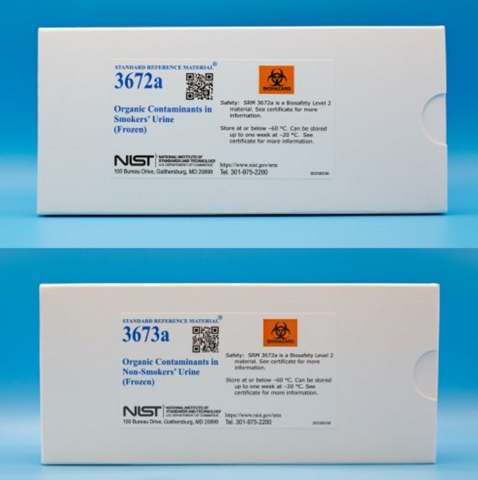
Credit: Lane Sander
According to the Office of the US Surgeon General, approximately one in five deaths annually is related to smoking. Additionally, the economic impact of smoking costs the US an estimated $600 billion (2018) in healthcare costs and lost productivity due to illness and premature death. To track human exposures to smoke and other chemicals, CDC has been measuring bioindicators of smoking in the US population for 25 years. Using NIST’s urine materials that provide trusted measurements of nicotine and other smoking metabolites, trends in smoking, vaping, and exposure to secondhand and thirdhand smoke can be identified and data reliably compared to previous years. Tracking the rise and fall of exposure metabolites can help experts validate self-reported data and inform tobacco or chemical control policies to reduce exposure health risks.
Accurate measurement of chemical metabolites is crucial for understanding human exposure and associated health risks. To support the exposure science community, NIST in collaboration with CDC recently released the next generation of two materials, SRM 3672a Organic Contaminants in Smokers’ Urine and SRM 3673a Organic Contaminants in Nonsmokers’ Urine, that are essential for ensuring the validity and comparability of routine health care measurements and long-term population studies. This most recent update includes over 100 analytes for the smokers’ material and more than 80 analytes for the nonsmokers’ material, including modern metabolites that reflect the exposures of contemporary society such as pesticide residues, personal care product metabolites, and replacement chemicals for compounds deemed unsafe in recent years.
As the US National Metrology Institute (NMI), NIST provides materials like SRMs 3672a and 3673a to enable users to establish metrological traceability to the International System of Units (SI) and harmonize measurements conducted across different laboratories and timescales. The international network of NMIs, including NIST, maintains measurement equivalence through SI traceability and provides standards for reliable measurement quality of legacy and emerging contaminants to support informed decision-making, policy development, and public health protection, ultimately helping to mitigate the adverse effects of environmental exposures on human health. These standards ensure for decades to come, in laboratories around the world, measurement of exposure metabolites will be accurate and comparable.
Legal Disclaimer:
EIN Presswire provides this news content "as is" without warranty of any kind. We do not accept any responsibility or liability for the accuracy, content, images, videos, licenses, completeness, legality, or reliability of the information contained in this article. If you have any complaints or copyright issues related to this article, kindly contact the author above.
