

Vestibular Testing Systems Market Forecast 2026-2036: Market to Reach USD 1,730.0 million at a 6.1% CAGR by 2026
Vestibular Testing Systems Market size
Vestibular Testing Systems Market Size and Share Forecast Outlook 2025 to 2035
ROCKVILLE, MD, UNITED STATES, March 23, 2026 /EINPresswire.com/ -- The global landscape for balance disorder diagnostics is undergoing a seismic shift. According to the latest market intelligence, the global Vestibular Testing Systems Market is valued at USD 960.0 million in 2025 and is projected to climb to USD 1,730.0 million by 2035. This represents a staggering 80.2% absolute growth over the next decade, expanding at a compound annual growth rate (CAGR) of 6.1%.As the global population ages, the prevalence of vestibular dysfunction and fall-related injuries has become a critical focal point for healthcare providers. The market is evolving from traditional manual assessments toward sophisticated, high-speed digital systems that offer unparalleled diagnostic precision.
Get Access of Report Sample https://www.factmr.com/connectus/sample?flag=S&rep_id=1313
Key Growth Drivers: Demographics and Digital Transformation
The primary catalyst for market expansion is the increasing global aging population. Demographic shifts and modern lifestyle factors have led to a rise in balance disorders, necessitating advanced diagnostic equipment that can provide comprehensive assessments in high-pressure clinical environments.
""We are seeing a fundamental transition in how balance disorders are managed,"" states a senior market analyst. ""Healthcare providers are no longer looking for standalone tools; they are seeking integrated diagnostic platforms that combine clinical excellence with workflow efficiency.""
Critical growth factors include:
Preventive Healthcare Focus: A rising emphasis on early diagnosis to prevent falls, particularly in geriatric care.
Technological Maturation: The shift from analog to digital systems, emphasizing diagnostic automation and clinical reliability.
Value-Based Care: Increased adoption of systems that provide superior diagnostic insights without compromising the patient experience.
Emerging Trends: The Rise of AI and Telemedicine
Between 2030 and 2035, the market is expected to enter a high-innovation phase, contributing over 54% of the total decadal growth. This period will be defined by the integration of Artificial Intelligence (AI) and Machine Learning (ML).
Automated analysis systems are now being developed to exceed traditional testing capabilities, offering intelligent diagnostic support that minimizes human error. Furthermore, the expansion of telemedicine and remote monitoring is breaking geographical barriers, allowing specialized vestibular consultations to occur outside of major metropolitan hubs.
Segmental Insights: VNG Systems and Hospital Dominance
The market is categorized by product, end-user, and application, with specific segments showing clear leadership:
Videonystagmography (VNG) Leads by Product: Holding a 46.0% market share in 2025, VNG technology remains the gold standard. Its ability to provide detailed eye-movement data with superior patient comfort makes it the foundation of modern vestibular clinics.
Hospitals as Primary End-Users: Hospitals are projected to command 58.0% of the market share in 2025. These institutions are increasingly investing in neurology units and emergency departments equipped with comprehensive testing options to handle complex cases.
Vertigo Diagnosis Leads Applications: Accounting for 42.0% of utilization, vertigo diagnosis is the backbone of the market, driven by the need for accurate tools to support complex clinical decision-making.
Regional Outlook: USA and Mexico Lead the Charge
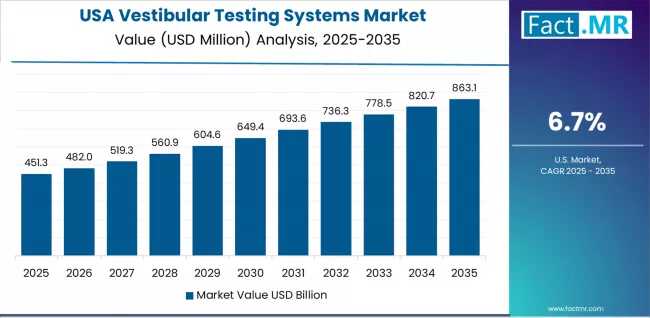
The United States remains the global frontrunner, projected to exhibit a 6.7% CAGR through 2035. This growth is fueled by a robust medical device sector and significant investments in specialized healthcare services across medical corridors in California, Texas, and the Northeast.
In Europe, the market is set to grow from USD 288.0 million to USD 519.0 million. Germany holds the lion's share (27.8% in 2025), driven by its reputation for medical technology excellence and precision manufacturing.
Asia-Pacific markets are also showing strong momentum. South Korea (5.5% CAGR) and Japan (5.4% CAGR) are prioritizing ""quality excellence"" and integrated hospital applications, with a strong focus on localized clinical support and remote diagnostic capabilities.
Competitive Landscape
The global market is characterized by strategic collaborations between multinational manufacturers and regional healthcare integrators. Key players are focusing on cloud-based platforms and telemedicine-enabled consultations to maintain a competitive edge.
Key companies profiled in the market include:
Interacoustics
GN Otometrics
Neuro Kinetics
Micromedical
Synapsys
ICS Medical
Strategic Outlook: Future Opportunities
The future of the Vestibular Testing Systems market lies in precision diagnostics. As medical applications become more sophisticated, the demand for application-specific diagnostic capabilities will rise. The integration of connected health systems and the development of personalized medicine protocols will offer significant opportunities for investors and manufacturers alike to redefine the standards of patient-centered care.
To View Related Report :
Eye Testing Equipment Market https://www.factmr.com/report/eye-testing-equipment-market
HSV Testing Market https://www.factmr.com/report/hsv-testing-market
Blood Testing Devices Market https://www.factmr.com/report/2680/blood-testing-devices-market
Dengue Testing Market
About the Research Company
Fact.MR is a leading provider of market intelligence and strategic consulting. With a focus on high-growth industrial sectors—including medical devices, automotive technology, and advanced materials—the firm provides executive-level insights designed to support data-driven decision-making for CXOs and investors worldwide.
S. N. Jha
Fact.MR
+1 628-251-1583
email us here
Legal Disclaimer:
EIN Presswire provides this news content "as is" without warranty of any kind. We do not accept any responsibility or liability for the accuracy, content, images, videos, licenses, completeness, legality, or reliability of the information contained in this article. If you have any complaints or copyright issues related to this article, kindly contact the author above.
