

New Study Finds OHIP Reimbursement Restrictions Reduced Liver Fibrosis Screening in Diabetes
Reimbursement restrictions reduce liver fibrosis screening in adults with diabetes in Ontario: a population-based interrupted time series analysis
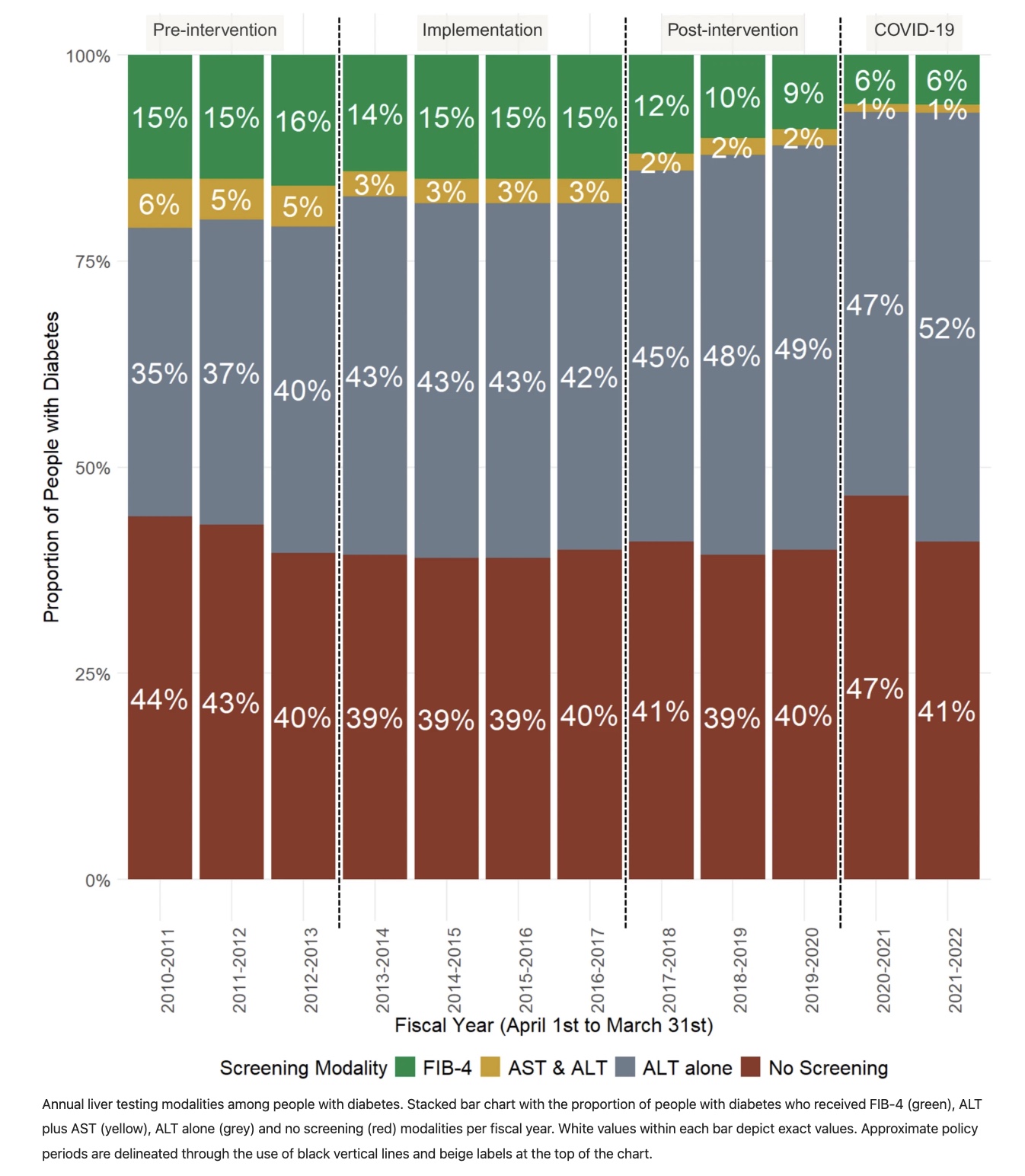
"Annual liver testing modalities among people with diabetes. Stacked bar chart with the proportion of people with diabetes who received FIB-4 (green), ALT plus AST (yellow), ALT alone (grey) and no screening (red) modalities per fiscal year. White values
Fatty Liver Alliance logo
Study of more than 1.6 million adults with diabetes found fewer liver fibrosis assessments after AST reimbursement restrictions.
Key Findings:
- Population-based study including more than 1.6 million adults with diabetes in Ontario
- Restrictions on OHIP reimbursement for AST testing were associated with reduced liver fibrosis screening
- Findings highlight the importance of aligning reimbursement policies with evidence-based screening recommendations for people at risk of advanced liver disease
The population-based study included more than 1.6 million adults with diabetes in Ontario and evaluated how a 2013 policy restricting OHIP reimbursement for aspartate aminotransferase (AST) testing influenced liver fibrosis screening between 2010 and 2022. AST is one of the laboratory tests required to calculate the Fibrosis-4 (FIB-4) Index, a simple, inexpensive, guideline-recommended tool used in primary care to identify individuals at risk for advanced liver fibrosis.
The researchers found that following the reimbursement restriction, liver fibrosis screening declined, suggesting the policy may have unintentionally created a barrier to identifying people at high risk for advanced liver disease.
Metabolic dysfunction-associated steatotic liver disease (MASLD) affects an estimated one in three adults globally and is particularly common among people living with type 2 diabetes. Without early identification, some individuals may not be diagnosed until they develop advanced fibrosis, cirrhosis, liver failure, or liver cancer.
The findings come at a pivotal time as healthcare systems around the world work to improve early detection of liver disease and prepare for the expanding availability of effective therapies for metabolic dysfunction-associated steatohepatitis (MASH). Last year, Diabetes Canada released the first Canadian clinical practice guidelines to include advanced fibrosis screening with FIB-4 for people with type 2 diabetes.
“Clinical practice is influenced not only by scientific evidence and clinical guidelines, but also by system-level factors like health policies that determine whether evidence-based interventions can be implemented in routine care,” said Dr. Sahar Saeed, epidemiologist, Assistant Professor in the Department of Public Health Sciences at Queen’s University, and senior author of the study. “Our findings underscore the importance of routinely evaluating reimbursement policies to ensure they support the delivery of quality health care.”
"There are so many factors that contribute to who gets a laboratory test, when, where, and how." said Jessica Burnside, lead author and medical student at Queen's University. "This study suggests that system level decisions may have had a significant role in shaping liver assessment trends since 2010 in Ontario. Given that Diabetes Canada has recently included liver fibrosis screening in their clinical guidelines, our findings provide important context for how to support this shift in practice."
"As new treatments become available for MASH, identifying people at risk before they develop advanced liver disease has never been more important," said Michael Betel, President and Founder of the Fatty Liver Alliance and a co-author of the study. "This research demonstrates that implementing evidence-based screening requires more than clinical guidelines. Healthcare policies and reimbursement decisions must support access to simple tools like FIB-4 so that patients can be identified early, referred appropriately, and receive the care they need."
The authors emphasize that the findings have implications well beyond Ontario. As healthcare systems increasingly implement liver fibrosis screening pathways, reimbursement and policy decisions should support, rather than inadvertently hinder, evidence-based care for people at increased risk.
The authors hope these findings will help inform future policy decisions that balance responsible healthcare spending with equitable access to evidence-based preventive care.
About the Study:
The study, "Reimbursement restrictions reduce liver fibrosis screening in adults with diabetes in Ontario: a population-based interrupted time series analysis," analyzed healthcare data from more than 1.6 million adults with diabetes in Ontario to evaluate the impact of restrictions on OHIP reimbursement for AST testing on liver fibrosis screening.
The article is published in Scientific Reports (Nature Portfolio) and is available as an open-access publication.
DOI: https://doi.org/10.1038/s41598-026-48600-5
About the Fatty Liver Alliance:
The Fatty Liver Alliance is a Canadian registered charity dedicated to improving awareness, education, early detection, advocacy, and support for people affected by metabolic dysfunction-associated steatotic liver disease (MASLD) and metabolic dysfunction-associated steatohepatitis (MASH). The organization works with patients, healthcare professionals, researchers, governments, and industry partners to advance liver health across Canada and internationally.
Website: fattyliver.ca
LinkedIn: https://www.linkedin.com/company/fatty-liver-alliance/
President: Michael Betel
Media Contacts
Sahar Saeed, MSc PhD
Senior Author
Assistant Professor, Queen's University
Email: sahar.saeed@queensu.ca
Jessica Burnside, MSc
Lead Author
Medical Student, Queen's University
Email: jessica.burnside@queensu.ca
Michael Betel
Fatty Liver Alliance
email us here
Visit us on social media:
LinkedIn
Facebook
X
Other
Legal Disclaimer:
EIN Presswire provides this news content "as is" without warranty of any kind. We do not accept any responsibility or liability for the accuracy, content, images, videos, licenses, completeness, legality, or reliability of the information contained in this article. If you have any complaints or copyright issues related to this article, kindly contact the author above.
